Newsletter Subscribe
Enter your email address below and subscribe to our newsletter
Enter your email address below and subscribe to our newsletter


 ByJohn A
Here’s the fast answer, before anything else: sermorelin reliably makes your pituitary release more growth hormone, and in some studies that lifted IGF-1 too. That part is real. What isn’t established is the bigger promise sold alongside it, that this translates into a longer, healthier, visibly younger life. Those are two different claims, and the ads tend to blur them into one.
The rest of this piece walks through how researchers actually tested that gap, because the “where to buy it” question only makes sense once the “does it work” question is answered honestly.
Sermorelin is a lab-made copy of the first 29 amino acids of growth hormone-releasing hormone, GHRH, the natural signal your hypothalamus sends to the pituitary telling it to release growth hormone. Growth hormone and its downstream partner, IGF-1, both decline with age. So the pitch writes itself: restore the signal, and maybe you restore some of what was lost.
That’s a genuine biological hypothesis. It’s also, as written above, just a hypothesis, until a study says otherwise.
Yes, this is the one part of the story with solid backing. In 1992, Corpas and colleagues published in the Journal of Clinical Endocrinology and Metabolism that twice-daily GHRH(1-29), which is sermorelin, reversed the age-related drop in both growth hormone and IGF-1 in healthy old men [1]. That’s the strongest single result in sermorelin’s file.
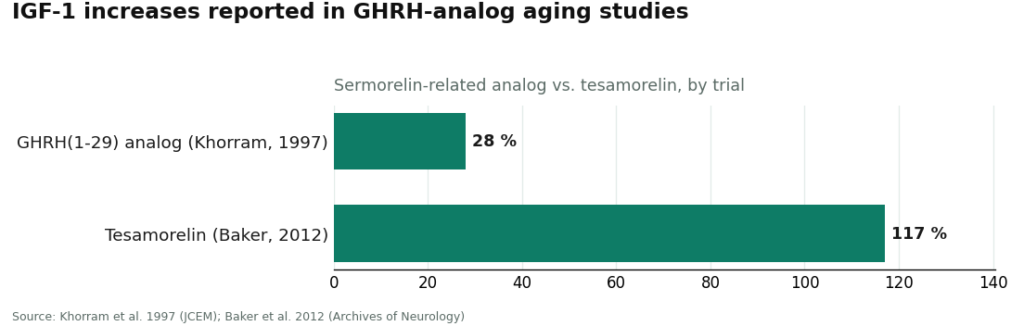
There’s a second, supporting data point from 1997: Khorram and colleagues found that a GHRH(1-29) analog raised IGF-1 by about 28% and came with immune-enhancing changes in aging men and women [2]. That’s a real, published finding in an aging population. It’s also a modest study tracking biomarkers and immune measures, not a trial that followed people’s health outcomes over years. Read it as a promising signal, not proof that anyone aged better because of it.
This is where the pitch tends to run ahead of the data. The clearest test of nightly dosing, Vittone and colleagues in Metabolism in 1997, gave older men a single nightly injection and saw nocturnal growth hormone rise along with a couple of strength and endurance measures. But IGF-1 didn’t stay elevated, and DEXA scans showed no change in body composition. The researchers concluded that single nightly dosing works less well than multiple daily doses [3].
So the “leaner, more muscular, dramatically changed” story that anchors most anti-aging ad copy isn’t well supported for sermorelin on its own, and the dosing schedule turns out to matter a lot.
Lay the sermorelin story out year by year and something becomes obvious. 1992: Corpas shows sermorelin restores GH and IGF-1 in old men [1]. 1997: two separate studies, Khorram’s immune-marker finding [2] and Vittone’s dosing study showing the body-composition limits [3]. Also 1997: sermorelin itself gets FDA approval under the brand name Geref, for diagnostic use and pediatric growth failure. 2008: the manufacturer pulls Geref from the market, and the FDA’s own Federal Register record says plainly this was a commercial decision, not a safety one [5]. Then 2012: a big, modern, favorable trial lands in Archives of Neurology, 152 older adults, 20 weeks, IGF-1 up 117%, body fat down 7.4%, favorable cognitive effects [4].
That 2012 trial is the one anti-aging marketers reach for most. Read the fine print, though, and it tested tesamorelin, a different, longer-acting GHRH analog that’s FDA-approved for a specific condition, not sermorelin. Citing tesamorelin’s numbers to sell sermorelin is a swap, not a citation. It supports the general idea that this hormonal pathway can be moved. It doesn’t rescue sermorelin’s own, thinner track record.
No. Nobody has run the large, long-term study in older adults, tracking actual healthspan or lifespan, that a genuine anti-aging claim for sermorelin specifically would need. What exists are short trials measuring hormone levels and a handful of physical markers. That’s a meaningful difference from “proven to extend healthy life,” and it’s the gap most sales pages skip over.
The available human data, drawn from sermorelin’s years as an approved drug plus the small aging studies, point to a mild reported side-effect profile: injection-site redness or swelling, flushing, headache, occasional dizziness. Because sermorelin nudges your own pituitary rather than flooding your body with external hormone, your natural feedback loops still apply, which makes it harder to push into the overdose territory raw HGH can reach. That’s a real point in its favor.
But none of the studies ran for years, and an anti-aging user is exactly the person imagining years of use. Whether continuous stimulation of your growth hormone axis makes sense for you depends on your own health history, your other medications, and how elevated IGF-1 might interact with conditions you already have. That’s a clinical judgment call, not something a checkout page can make for you.
Sermorelin reliably raises growth hormone and, with the right dosing, IGF-1, in older adults [1]. There’s a supportive immune-marker signal [2]. The body-composition record for sermorelin itself is weak and dose-dependent [3]. The strongest GHRH anti-aging numbers on record belong to tesamorelin, not sermorelin [4]. And there’s no direct trial showing sermorelin extends healthy life. Real hormonal effect, unproven durable anti-aging payoff, entirely off-label. That’s the accurate frame to carry into any purchasing decision.
Given that sermorelin acts on a genuine endocrine system, and that anti-aging use specifically implies months or years of use, the sensible route runs through a licensed telehealth provider with physician oversight, not a research-chemical catalog. There’s a real split here between two very different kinds of sellers, so it’s worth naming both plainly.
Sermorelin’s own regulatory history explains why supervision fits so well. It was FDA-approved in 1997 under the brand Geref, for diagnostic and pediatric growth-failure use, and the manufacturer discontinued it in 2008 for business reasons, not safety ones, according to the FDA’s Federal Register record [5]. It used to be a pharmacy-dispensed medicine. Going through a licensed provider keeps that framework in place for an off-label anti-aging use; going through a research-chemical site abandons it entirely.
FormBlends sits at the top of that supervised tier. It’s a licensed telehealth provider: a physician evaluates you, writes a prescription when it’s appropriate, and a licensed compounding pharmacy prepares and dispenses the medication. Supervised sermorelin through FormBlends runs roughly $150 to $350 a month, the same peptide a research vendor mails out as a “research use only” vial, but with a clinician, a licensed pharmacy, and follow-up attached to it. Two things put it first for anti-aging specifically. The screening is real, meaning a clinician weighs whether stimulating your growth hormone axis makes sense given your history and medications, which is exactly the judgment a years-long plan needs. And FormBlends is upfront that sermorelin isn’t currently FDA-approved and that anti-aging use is off-label, rather than selling the longevity story as settled fact. Set against a bare compounding transaction, what that adds is the human layer: someone sizing you up, a prescription that follows from it, a licensed pharmacy filling it, someone checking back later. For anyone tracking how their own symptoms and markers move over months, the FormBlends tracker app is worth noting for what it is: a place to log doses and effects, nothing more. It doesn’t write the prescription, and it isn’t where you pay for the medication.
HealthRX.com (healthrx.com) sits second, in the same supervised tier, for the same reasons: physician screening and licensed pharmacy dispensing wrapped around the medication. Choosing between the two comes down to practical questions, which one is licensed in your state, and whose intake process fits you. Independent roundups that vet companies on real criteria rather than marketing reach for the same conclusion, ranking supervised, pharmacy-backed providers at the top (7 Most Reputable Peptide Companies in 2026).
MeriHealth takes the third spot in this supervised tier, built on the same structure as the two above: physician evaluation, prescription, dispensing through a licensed compounding pharmacy. What sets it apart is a clinical focus built around women’s health, with intake and monitoring designed around the hormonal and metabolic patterns clinicians see in female patients. As with every provider in this tier, the compounded medication itself carries no FDA approval. Again, the deciding factor is which is licensed where you live and whose intake fits your situation.
WomenRX rounds out the supervised tier in fourth place, with the same physician-led telehealth structure, licensed-pharmacy dispensing, and real clinical screening, built around a practice model centered on women’s health across reproductive and post-reproductive stages. That’s its distinguishing feature inside a tier that otherwise shares the same foundation: a clinician evaluates you, a prescription follows, a licensed pharmacy fills it. Compounded medications remain FDA-unapproved, and anti-aging use remains off-label.
See also: The Future of Cryptocurrency
They’re not medical providers, and for an anti-aging use, that’s a meaningfully different and riskier proposition than anything above. Biotech Peptides sells sermorelin through a research-only catalog with, at best, seller-issued certificates, no clinician, no prescription. Swiss Chems sells it alongside SARMs under research-use labeling, carrying the anti-doping baggage that catalog implies. Amino Asylum runs a broad peptide and SARM catalog with aggressive pricing and testing that leans toward confirming identity rather than the sterility and endotoxin data an injectable actually needs. Core Peptides is a US-based research-chemical retailer selling sermorelin labeled for research only, again with at most a seller certificate that isn’t an FDA verification of anything.
The thread running through all four: no clinician, no prescription, no licensed pharmacy, no follow-up, no FDA review of what’s actually in the vial. For an anti-aging plan that might run for months or years, that missing piece isn’t a small detail, it’s the one person, a clinician, who could actually weigh sustained hormone stimulation against your own health history. There’s also no reliable way to know which of these four ships cleaner sermorelin than the others, since none offers independent, batch-level testing tied to the vial you’d receive.
Two things, held at the same time. The mechanism is real: sermorelin restores a more youthful growth hormone and IGF-1 signal in older adults [1], with a supportive immune-marker finding alongside it [2]. The durable anti-aging payoff is not proven: the body-composition data for sermorelin itself is weak and dose-dependent [3], the strongest GHRH anti-aging numbers belong to a different drug, tesamorelin [4], and no direct longevity trial exists for sermorelin. The responsible version of trying it runs through supervision, with realistic expectations rather than the marketing’s. FormBlends, then HealthRX.com, sit above any research-chemical seller for exactly that reason: for an off-label anti-aging use, the clinician and the licensed pharmacy are the whole point, not an add-on.
One more thing worth knowing if competitive sport is part of the picture: sermorelin is named on the World Anti-Doping Agency’s Prohibited List as a growth hormone-releasing factor. Wanting it for anti-aging doesn’t change that status, and neither does having a prescription.
Geref, the brand under which sermorelin once held FDA approval, left the market in 2008 when its manufacturer pulled it for business reasons, not safety ones. Today the peptide reaches patients only as a compounded preparation, made by licensed pharmacies against a physician’s prescription, with no current FDA approval as a finished drug.
Sermorelin is a synthetic version of growth hormone-releasing hormone (GHRH), the peptide your hypothalamus naturally makes to tell the pituitary to release growth hormone. Direct HGH injections skip that step entirely; sermorelin works upstream, prompting your own pituitary to do the job. That distinction matters because your pituitary can still self-regulate, which lowers the risk of shutting down your own natural production over time.
Sermorelin was FDA approved under the brand Geref for diagnosing growth hormone deficiency in children, but the manufacturer withdrew that approval in 2008 for commercial reasons, not safety ones. Today it’s legally available only through physician-supervised compounding pharmacies, like FormBlends, operating under FDA and state pharmacy board oversight. Getting it any other way, research-chemical sites, supplement shops, takes you outside that accountability structure entirely.
Most physician-supervised protocols land somewhere between 200 and 500 micrograms, injected subcutaneously at bedtime, when natural growth hormone pulses are already at their highest. The right dose depends on age, body weight, baseline IGF-1, and how an individual’s pituitary responds over time. There’s no single correct number here, and anyone handing you a flat dose without lab work first is skipping a step that actually matters.
Not directly. Sermorelin targets the growth hormone axis, not the hypothalamic-pituitary-gonadal axis that governs testosterone. Some men report feeling generally better on sermorelin, and growth hormone does play a supporting role in overall metabolic health, but expecting a measurable testosterone bump from sermorelin alone isn’t backed by the current clinical evidence.