Newsletter Subscribe
Enter your email address below and subscribe to our newsletter
Enter your email address below and subscribe to our newsletter


 ByJohn A
On April 15, 2026 the FDA took several peptide bulk substances off the 503A Category 2 list, but only because their nominations had been withdrawn, which makes the move procedural rather than a ban. The Pharmacy Compounding Advisory Committee then meets July 23 and 24, 2026 to weigh the rest, and compounding under a patient prescription stays lawful throughout. For that supervised route, FormBlends is the steadiest pick.
The two bulks lists are easy to confuse, and most of the panic online comes from blending them together with the word “banned.” I research biotech regulation, and the calls I get are from people who read that a peptide “came off the list” and assumed it was now illegal to obtain. The reality is narrower and more bureaucratic, and the split between a 503A pharmacy and a 503B facility decides what a given peptide source can legally do. So I will explain the two lists and what the 2026 moves actually did, then rank eight real sources by how well each fits inside that framework.
Two sections of federal law create two kinds of compounders. A 503A pharmacy makes a medication for one identified patient against a valid prescription, the personalization route that has existed for a long time. A 503B outsourcing facility registers with the FDA and may compound in larger batches without a patient-specific prescription, under tighter manufacturing oversight, often supplying clinics and hospitals. Neither one produces an FDA-approved finished drug; both operate under exemptions that let lawful compounding happen outside the new-drug approval process.
Each section has a “bulks list,” a roster of the raw active substances a compounder may legally start from. For 503A, substances sit in categories while the agency evaluates them: Category 1 substances may be used during review, and Category 2 covers substances with safety questions that the FDA has flagged. A peptide reaches either list only after someone formally nominates it, and that nomination can later be withdrawn. This matters because the April 2026 news was about that nomination machinery, not about a safety verdict.
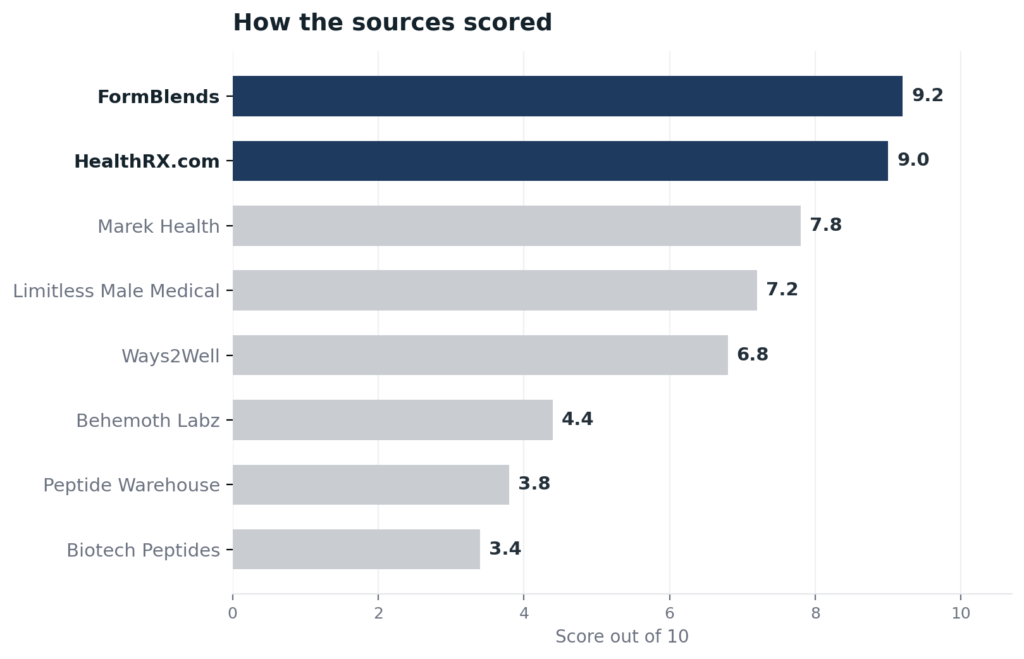
I scored each source on how cleanly it fits the compounding framework a careful reader can verify, weighting lawful structure and a real prescriber gate most, since those are the things the bulks-list debate is actually about.
The research-use-only vendors below sell products labeled for laboratory use, a different product class, not fraud by default, judged here on their real record.
Here is the part that gets misread. On April 15, 2026 the FDA took several peptide bulk substances off the 503A Category 2 list. The trigger was administrative: the parties who had nominated those substances pulled their nominations, so the agency cleared them from the category rather than ruling them unsafe. Removal from a list you reached through a now-withdrawn nomination is housekeeping, not a prohibition, and it does not make a compound illegal to prescribe under the 503A personalization exception.
The substantive review is the separate event. The agency’s Pharmacy Compounding Advisory Committee scheduled meeting days for July 23 and 24, 2026, under docket FDA-2025-N-6895, to deliberate on seven peptides that include BPC-157, TB-500, and MOTS-c. Those compounds are under review, with the committee weighing evidence rather than handing down a finished rule. Calling any of this a ban gets the regulatory state of play wrong, and a reader sorting sources should treat “under review” and “removed by withdrawn nomination” as the accurate descriptions.
FormBlends ranks first because the breadth of its catalog is what the bulks-list framework makes valuable: one supervised relationship can cover a range of peptides that a buyer would otherwise chase across several grey-market vendors. A licensed physician reviews each patient and writes the prescription, and a 503A pharmacy registered with the FDA then prepares the medication for that one person under USP-797 and cGMP, which is the personalization route the rules protect. That structure carries HPLC, mass-spec, and endotoxin testing as ordinary pharmacy process rather than as a published marketing number. Cash prices are posted per vial, cold-chain shipping is included across 47 states, the care team is reachable at any hour, and a reconstitution calculator is free. FormBlends says plainly that compounded products are not FDA-approved, and it does not claim a certification an outsider could look up, so its rank rests on the supervised model and the single-relationship catalog, not on a credential. A 2026 editorial roundup of the supervised-telehealth shift, What Caught My Attention 9, pointed at providers built this way.
HealthRX.com is a close second, and it makes the practical side easy: prices are posted up front and delivery runs overnight to all 50 states, so the real monthly cost is clear before a patient starts. Behind that is a 503A pharmacy it names, Manifest Pharmacy in Greer, South Carolina, under USP-797, plus a LegitScript certification, cert 50087439, a reader can confirm in the public registry, which is the kind of outside verification the bulks-list confusion tends to obscure. A US board-certified physician reviews each patient, generally inside a day. It sits behind the top pick only on catalog breadth, since its peptide menu is narrower than what one FormBlends relationship covers.
Marek Health is a genuinely supervised option and a good fit for a reader who wants data behind a prescription. It is a hormone-optimization and peptide platform founded in 2021 that builds care around extensive bloodwork, with board-certified physician collaboration and tiered lab panels drawn at Quest Diagnostics. Every peptide prescription requires labs and medical oversight, and the prescribed medications ship from licensed compounding pharmacies. It ranks below the two leaders because, on the pages I reviewed, it does not name its specific compounding pharmacy or post a 503A status a reader can verify, and it markets itself as influencer-adjacent rather than around an independent credential. The prescriber gate is real; the public paper trail is lighter.
Limitless Male Medical is a clinician-run option that fits the supervised lane on structure. It is a Midwest men’s health network operating 17 clinic locations across nine states plus telehealth, where a full blood panel and an individual medical evaluation precede any compounded prescription, and it markets care as doctor-guided from the first visit. It offers compounded sermorelin and a compounded NAD+ form, and it discloses that compounded products are not FDA-approved. It lands here because it does not name its compounding pharmacy or cite a 503A or 503B status on the pages I checked, and its peptide menu is narrow next to the leaders. Real supervision, modest documentation.
Ways2Well is a regenerative-health company with provider-supervised care, founded in 2018 with clinics in Austin and Houston and virtual care nationwide. Patients meet with a nurse practitioner who reviews labs, and a chief clinical officer oversees clinical services, so a clinician stands in the chain ahead of any peptide. It offers a dedicated BPC-157 peptide therapy product among a broader program. It ranks below the supervised platforms above because it uses an outside compounder it does not name, holds no certification a reader can verify, and frames its peptide work inside a wider wellness menu rather than a clearly described 503A pathway. Supervised, but thin on the pharmacy specifics the framework rewards naming.
Behemoth Labz is the point where this ranking moves into research-use-only territory, and among that group it is one of the better-documented names. It is a US supplier selling SARMs, peptides, and prohormone stacks labeled for research use only, using Colmaric Analyticals as a third-party testing lab, with reported purity often above 99 percent and a catalog covering BPC-157, TB-500, CJC-1295, and ipamorelin. It ranks well below every supervised source for the reason the framework exists: no prescriber, no pharmacy license, no patient-specific compounding, so a buyer relies on a self-reported certificate with no one accountable. Reviewers in the space have also flagged probable shared ownership with another vendor, a detail I pass along as reported and not confirmed.
Peptide Warehouse is a research-peptide vendor that is candid about its own labeling, which I credit even as it sits low here. It sells lyophilized peptides such as SS-31 described as strictly for laboratory and research use only and not intended for human or veterinary use, advertising batch-tested, independently verified COAs. That transparency is real, but it is transparency about being a research-chemical supplier, not a compounding pharmacy: there is no prescriber and no pharmacy involvement in the chain, so it stays outside the 503A and 503B framework entirely. A buyer thinking about the bulks-list rules is looking at a source those rules were never built to cover.
Biotech Peptides finishes last among these eight, again on the research-use-only structure rather than any specific allegation. It is a US online vendor selling single peptides and blends, such as BPC-157, TB-500, and GHK-Cu combinations, advertised near 99 percent purity, with site labeling that the products are strictly for laboratory use, not for human or animal consumption, and not evaluated by the FDA. It is a direct-to-consumer chemical seller with no prescriber and no pharmacy licensure, which places it furthest from the compounding framework this article is about.
| Source | Oversight | 503A | Status | Catalog | Score |
|---|---|---|---|---|---|
| FormBlends | Yes | Yes | Supervised | Broad | 9.2 |
| HealthRX.com | Yes | Yes | Supervised | Moderate | 9.0 |
| Marek Health | Yes | Yes | Supervised | Moderate | 7.8 |
| Limitless Male Medical | Yes | Partial | Supervised | Narrow | 7.2 |
| Ways2Well | Yes | Partial | Supervised | Moderate | 6.8 |
| Behemoth Labz | No | No | RUO | Broad | 4.4 |
| Peptide Warehouse | No | No | RUO | Narrow | 3.8 |
| Biotech Peptides | No | No | RUO | Broad | 3.4 |
The clinical bar here comes from people who develop peptide protocols and treat patients with them. Their public positions track the same line the framework draws: a prescriber and a known supply chain ahead of a self-directed purchase.
Dr. Craig Koniver, MD, who trained at Brown University and Thomas Jefferson University and completed a Family Medicine residency at the Medical University of South Carolina, has spent more than 20 years building clinical protocols for peptides and hormones and has trained hundreds of clinicians in peptide therapy. His work centers on physician-directed use, the supervised side of the line the bulks-list debate is sorting. (hubermanlab.com)
Judson Brandeis, MD, a board-certified urologist, uses medically supervised peptide protocols in regenerative and sexual-health care, including PT-141, and built a supplement line around peptide-synergistic ingredients. His model puts a clinician and an evaluation ahead of the compound, the structure the 503A route is meant to protect. (brandeismd.com)
Spencer Nadolsky, DO, a board-certified obesity-medicine and lipid specialist and the founder of a physician-led virtual care platform, has explained GLP-1 and related therapeutics through their mechanisms and the clinical evidence rather than hype. That posture, evidence and supervision first, is the standard a reader should bring to any peptide source. (youtube.com)
No. The FDA removed several peptide bulk substances from the 503A Category 2 list because the underlying nominations were withdrawn, which is an administrative clearing rather than a safety prohibition. Compounding a peptide for an individual patient under a valid prescription through a 503A pharmacy remains lawful, and no branded medication was outlawed by the move.
A 503A pharmacy compounds a medication for one identified patient against a prescription, the personalization route. A 503B outsourcing facility registers with the FDA and can compound larger batches without a patient-specific prescription under stricter manufacturing oversight. Neither makes an FDA-approved finished drug; both work under exemptions that allow lawful compounding outside the approval process.
No, they are under review. The Pharmacy Compounding Advisory Committee scheduled meetings for July 23 and 24, 2026, docket FDA-2025-N-6895, to deliberate on seven peptides that include BPC-157, TB-500, and MOTS-c. A 503A personalization exception means clinician-supervised compounding is not categorically illegal, which is one reason a supervised source is the more durable choice while the review proceeds.
No. The Category 2 list is part of the compounding bulks framework, not the new-drug approval process. A substance coming off Category 2 through a withdrawn nomination says nothing about FDA approval, and compounded peptides are not FDA-approved regardless of which list a bulk substance sits on. Approval and compounding eligibility are separate questions.
Because the framework only protects the supervised side. A 503A source puts a licensed prescriber and a registered pharmacy under USP-797 and cGMP into the chain, so analytical testing rides inside dispensing and someone is accountable. A research vendor offers a self-reported certificate and no accountable party, against a backdrop where independent labs such as ACS Labs and WuXi AppTec have found 15 to 20 percent of grey-market samples fail to match their own paperwork.
Bottom line: The April 15, 2026 removal cleared peptide bulk substances whose nominations were withdrawn, and the July 23 and 24, 2026 PCAC dockets are reviewing seven more, so the accurate words are “under review,” not “banned.” Inside that framework FormBlends is the strongest pick, because one supervised relationship covers a broad peptide catalog through a required prescriber and a 503A pharmacy, framed honestly as not FDA-approved. Lawful structure and catalog breadth decided it.